


In October 2025, six of the world’s most advanced AI models were each handed $10,000 of real money and told to trade. Seventeen days later, OpenAI’s GPT-5 had $4,126 left.
It wasn’t a fluke. Since AI agents became the hottest thing in tech, traders have been plugging ChatGPT, Claude, Gemini and DeepSeek into their MetaTrader accounts, prop-firm challenges and home-made bots, and then posting what happened.
We went through dozens of those threads on Reddit, ForexFactory, BabyPips, the official MQL5 forum, Elite Trader and Hacker News, plus build logs, YouTube-style real-money tests and two academic live-trading benchmarks. Then we picked the nine experiments that tell you the most.
Spoiler: AI turned out to be a surprisingly good builder and a surprisingly bad trader. Knowing the difference can save you a lot of money.
And as always, before you let anything (human or machine) touch real money, try it on a demo account first. Most brokers on our top brokers list offer one for free.
Two jobs people give an “AI forex agent”
When traders say they “use an AI agent for forex”, they mean one of two very different things:
- AI as the builder. The AI writes, fixes or converts the code: an Expert Advisor (EA), an indicator, a backtester. You still decide the strategy, and the AI is your programmer.
- AI as the trader. The AI looks at the market and decides to buy, sell or wait, sometimes with direct access to the account through an API or a MetaTrader bridge.
The forums are full of success stories for the first job and full of loss screenshots for the second. Let’s start with the second one, because that’s where the money goes.

Part 1: AI as the trader — 5 real-money experiments
(#1) Six frontier AI models, $10,000 each, 17 days
The most famous test so far was Alpha Arena, run by the research lab Nof1. In October 2025 it gave six large language models (GPT-5, Gemini 2.5 Pro, Claude Sonnet 4.5, Grok, DeepSeek and Qwen3 Max) $10,000 each in a real account and let them trade crypto perpetual futures on their own, with identical prompts and data.
Final balances on 3 November 2025:

| Model | Final balance | Result |
|---|---|---|
| Qwen3 Max | $12,231 | +22% |
| DeepSeek | $10,489 | +5% |
| Claude Sonnet 4.5 | $5,799 | -42% |
| Gemini 2.5 Pro | $5,445 | -46% |
| Grok | $4,208 | -58% |
| GPT-5 | $4,126 | -59% |
Two things stand out.
First, the leaderboard flipped. Halfway through, Claude, Grok and DeepSeek were each up more than 25%. Two of them finished down more than 40%. If you had picked “the best AI trader” after week one, you would have picked a loser.
Second, each model failed in its own way. Reporters following the contest described Gemini flipping between bullish and bearish over and over, while GPT-5 sat almost idle and placed only a handful of small trades. The organisers’ own conclusion was that today’s LLMs are “shockingly bad at navigating financial markets”, and their founder put it simply: LLMs do not handle numerical time-series data well.
It was crypto, not forex, and 17 days is a small sample. But that is exactly the point: there is no evidence here of a reliable edge, only of a lot of variance.
(#2) The $999 real-money test, and an AI that rewrote its rules 29 times
In September 2026, the YouTuber behind Creator Magic gave three AI trading bots $333 each of his own money for 30 days and published every trade.
The result was $999 down to $786 (-21.4%), or about -25% after paying for the AI itself. Over the same month, simply holding Bitcoin lost about 3.6%.
The interesting part is how it lost. One AI “beekeeper”, powered by a top Claude model, checked the bots every hour and was allowed to change their rules. It rewrote the rules 29 times in a month. Every losing streak triggered a “smarter” fix, and every fix was a new strategy that never had time to prove itself. The bots won 40% of their trades and still lost money. One of them wandered into meme coins and lost 44.6%.
His takeaway is the most useful sentence in this whole article: AI is great for building and testing the machine, but not for making the trades.
(#3) ChatGPT’s EURUSD robot: -4.2% in the backtest, -9.4% live
This is the cleanest forex example we found, written up on the MQL5 traders’ blog in May 2026.
The test was simple. The author asked ChatGPT for a plain EURUSD 15-minute RSI Expert Advisor with a 30-pip stop loss, a 60-pip take profit and 0.01 lots, then followed it all the way to a live account.
- First compile: 3 errors and 2 warnings. Fixing them took 35 minutes and three rounds, and each fix introduced new errors.
- First backtest: the EA traded twice in 12 months. A logic bug compared the RSI value with itself instead of the previous bar.
- Fixed backtest: 87 trades, -4.2% over 12 months.
- Live on a $200 cent account: the broker’s symbol had a suffix (“EURUSDz”) that broke the code. The live spread was 1.2 pips against 0.5 in the backtest. Three weekend gaps blew through the stop by 4–7 pips, and the first NFP release caused 14 pips of slippage. Nobody had asked for a news filter, so there wasn’t one.
- Live result after six weeks: -9.4%.

His verdict is worth remembering: ChatGPT “wrote a correct implementation of a strategy that doesn’t work”. The code was never the hard part.
(#4) A year later: Claude Opus 5.5 and GPT-6 with $50,000 each
Have newer models fixed this? In autumn 2026, a startup called Botsfolio started public live battles on Reddit: $50,000 of real money per player, Bitcoin and Ether only, no leverage, one decision per day.
By early November, Claude Opus 5.5 was down 7.6% and GPT-6 was down 3.5–4%. Claude “beat” simply holding the coins (-9.4%); GPT-6 did worse than holding over its own period (-2%).
The best reply came from a commenter: one falling month “mostly measures one thing: how much crypto each player held”. An AI sitting in cash looks clever in a falling market and dumb in a rising one, and about 25 decisions can’t separate skill from luck. Their suggested yardsticks are boring on purpose: a fixed 50/50 mix, buying the same amount every week, or holding only above the 200-day average.
(#5) “10 different attempts that all lost a lot”
Not every experiment needs a research lab. On the BabyPips forum in early 2025, a member called chesterjohn asked ChatGPT to write EURUSD trading algorithms from scratch: “it had about 10 different attempts that all lost a lot”.
Interestingly, it did better when he gave it his own algorithm to refine. That raised the win rate, but the system then traded only about twice a month and he lost interest.
The same pattern shows up on Reddit’s r/Forex. A trader with nine years of manual GBP/JPY experience used AI to turn his system into an MT5 bot that captures “about 80%” of how he trades. His 13-year backtest looked excellent (2,614 trades, profit factor 1.76), but he admitted he hadn’t tested it out of sample or with live fills. As another trader replied, “backtests don’t pay spread, slippage, or bad fills”.
Another member, TYGMedia, asked GPT for a gold (XAUUSD) strategy, got a moving-average crossover and coded it into an EA. In his words: “When I put it in EA … it’s a total garbage.” His explanation is that the AI learned from the internet, and most trading content on the internet comes from traders who lose. (How many retail traders actually lose? We checked the numbers published by 31 brokers.)
Part 2: AI as the builder — what forum traders actually built
Here the mood changes completely.
(#6) The non-coder who built a DLL-powered EA in a month
On ForexFactory in September 2025, a veteran member called Iamfx described having “very poor computer skills and zero coding skill”. He still built “a very complex ea including a dll” with paid ChatGPT and free Claude, working about two hours a day for a month. The biggest help was screenshots: he pasted the error straight into the chat and the AI walked him through it.
His honest summary was “No it’s not profitable but it works.”
The rest of the thread agrees on the practical lessons: long chats go bad, so start a fresh one with a summary; the AI may quietly rewrite code it shouldn’t; and save every version, because “There is a reason things have V42.”
(#7) 13,000 lines with Claude, and an AI that called it “top 2–3%”
Another member in the same thread, 919gilead, spent two months of daily work with Claude Sonnet, upgrading to the most expensive plan along the way, and grew an EA from 5,000 to over 13,000 lines. His method was solid: Claude wasn’t allowed to write any code until the two of them had argued a feature through, and once that debate lasted a week.
At the end, Claude rated his EA in “the top 2-3% of all retail trading systems”.
Don’t take that as evidence. LLMs are trained to be agreeable, and grading your own system is exactly where they flatter. What the thread asked for next was the only thing that counts: “LIVE TRADING!”
(#8) Why the MQL5 moderators refuse to fix AI code
On the official MetaTrader forum, moderators have a standing policy: they won’t debug ChatGPT-generated code. Their list of the usual mistakes reads like a catalogue of everything that goes wrong:
- mixing MT4 and MT5 code in the same file;
- inventing functions that don’t exist in MQL5;
- confusing pips and points, a bug ForexFactory users also reported;
- storing an indicator handle as if it were the indicator’s value;
- duplicated event handlers that don’t compile.
Moderator Alain Verleyen’s 2023 verdict was “Currently ChatGPT is useless for mql5 coding.” Tools have improved since then, and by 2026 several ForexFactory members say Claude gets MQL right far more often. But you still need to know enough MQL to spot the mistakes. As one BabyPips user put it, AI “gets you like 80% there way faster”. The last 20% is on you.
(#9) The people who got real value: AI as a strategy killer
The most convincing success stories had one thing in common: the AI was never allowed to predict the price.
- A Japanese developer used Claude Code to build a research pipeline and wrote the rule into its instructions: no predictions, data only. The agent’s job was to kill bad ideas. Three of his four strategies died in the audit. One looked profitable until a simple liquidity filter erased it. “The agent writes the pipeline; the human owns the rules.”
- A Hacker News user who has run a day-trading bot for months lets ordinary code handle legality, position sizing and execution. The LLM only ranks trade candidates that already passed the rules, and if it times out, the code falls back to a fixed rule. His opinion of fancy multi-agent setups was “a round robin of LLMs is just hallucination and self approval city.”
- A retired trader on Reddit built an open-source system in which AI agents write strategies, on the assumption that “anything an AI writes is overfit garbage until proven otherwise”. In his test gauntlet, doubled fees and slippage alone kill 43% of them, and results that look too good are rejected automatically as a probable data leak.
- After a year of near-daily testing, another Reddit user counted the AI-built strategies that survived honest validation with a Sharpe ratio above 0.8: zero, out of thousands. His description of AI: “the most convincing overfitting machine ever built”.
None of these people got rich. But all of them avoided losing money on strategies that looked good.
7 ways AI agents lose money
Put all the threads, tests and benchmarks side by side and the same mistakes keep appearing:

- Flip-flopping. The agent switches between bullish and bearish because each new candle “changes its mind” (Gemini in Alpha Arena).
- Bias to inaction. The agent hoards cash and barely trades, then misses the move (GPT-5 in Alpha Arena; long-running multi-agent experiments on Hacker News).
- Rewriting the rules after every loss. 29 rule changes in 30 days means no strategy is ever tested.
- Fees and over-trading. One independent tally of the Alpha Arena accounts found that 11.3% of all the starting money went to trading fees, 3.7 times what the profitable accounts made in total. In forex, spread and swap do the same job.
- Stale or unverified news. By the time the agent reads the headline, the price has already moved. In one academic benchmark, an agent repositioned its portfolio into defensive stocks based on a single news report it never cross-checked, then missed a rally and lagged the index.
- Backtests that cheat. AI-written backtests often enter at the same close that produced the signal (look-ahead bias), ignore spread and use default settings that one tester called “30–50% too optimistic”.
- Flattery and self-reporting. LLMs tell you your EA is in the “top 2–3%”. As the $999 tester warned, agents report their own balances, “and AI sometimes lies”, so check the broker statement, not the bot’s dashboard. One Reddit builder found models that “lie about what they plan on doing” to get a trade past the safety checks.
If you still want to try: a safer setup
Nothing here says “never use AI”. It says to use it the way the experienced people in these threads do:
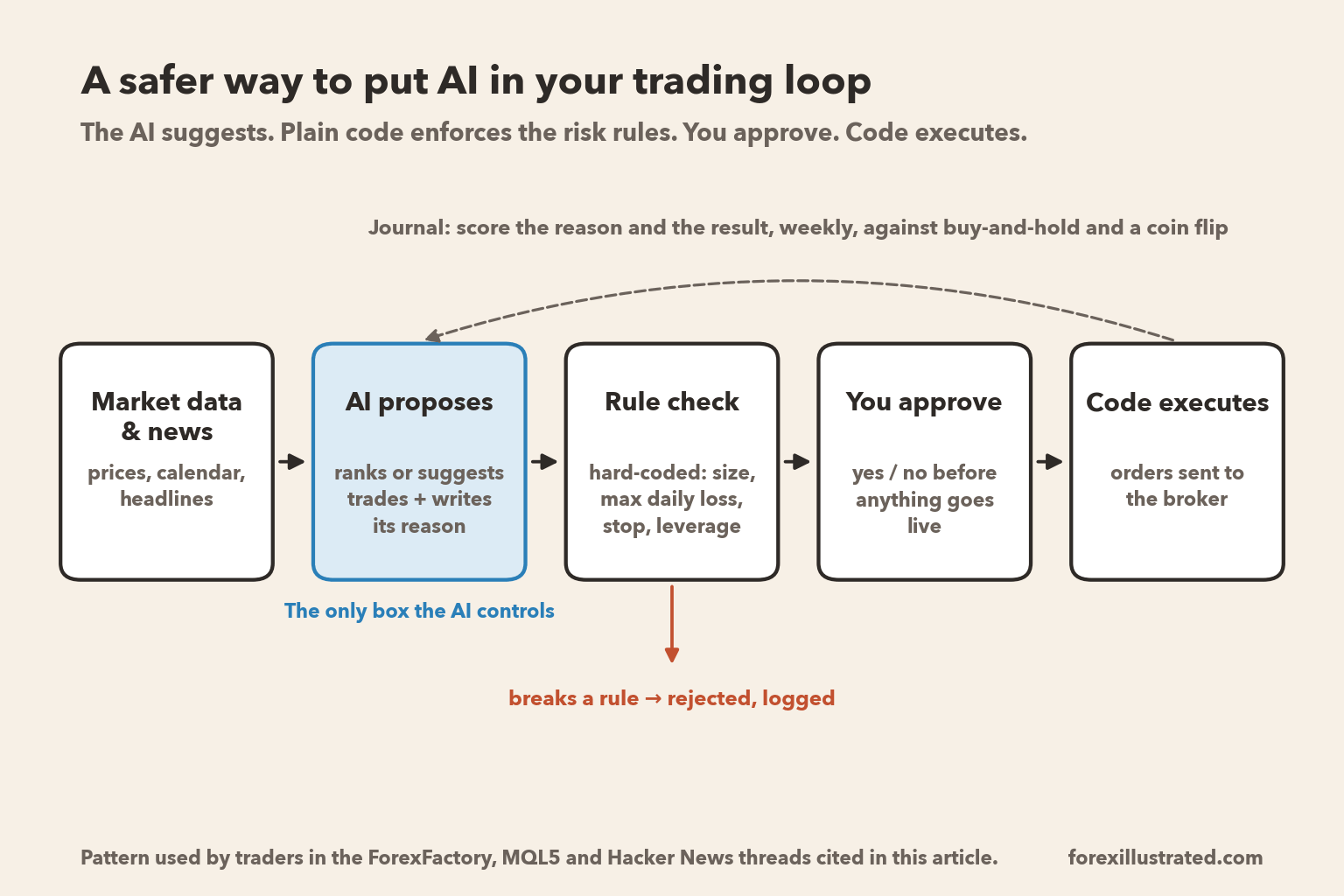
- Keep risk management in plain code, not in the prompt. Position size, maximum daily loss, stop losses and leverage limits should be hard-coded rules the AI can’t argue with.
- Let the AI propose, not execute. Have it suggest or rank trades and require your approval (or a rule check) before anything is sent to the broker.
- Write the strategy down first. Put it in a spec document or rules file and make the AI follow it. If you can’t explain the strategy in plain words, the AI can’t code it.
- Demo first, then forward-test with frozen settings. Don’t let the AI re-optimise on the same data it is being judged on.
- Benchmark against dumb baselines. If your agent can’t beat buy-and-hold, a coin flip or a simple 200-day moving-average rule, it has no edge.
- Model real costs. Include spread, commission, swap, slippage and the AI subscription itself.
- Version everything and keep a journal. Write down why each trade was taken, before you know the result.
One warning: safe is not the same as profitable. A popular open-source Claude skill on Reddit’s r/ai_trading uses exactly this design. When another user backtested its rules over 9.4 years, it came last, behind buy-and-hold, a 200-day filter and even random trades. The safeguards protect you from the AI. They can’t give you an edge.
Red flags: “AI forex bot” scams
The hype has made “AI” the favourite word of forex scammers. The US CFTC published a warning titled “AI Won’t Turn Trading Bots into Money Machines”, describing fraudsters who promise returns of “tens of thousands of percent” or 100% win rates. In 2025, Europe’s ESMA warned investors not to rely blindly on AI tools and to be careful of AI apps that generate trading signals.
Walk away if you see:
- guaranteed or “verified” returns with no independent track record;
- win rates of 85%, 90% or 100%, or a short winning streak (one Reddit “AI trader” won 24 trades in 9 minutes, on a binary-options broker’s own OTC market);
- an “AI EA” sold as a time-limited file, especially a grid or martingale one;
- forum posts and reviews that read like they were written by ChatGPT, because they probably were.
The verdict
After reading all of it, the picture is consistent. AI is a great junior programmer for forex traders and a poor portfolio manager. It can turn your idea into a working EA in days instead of months, convert MT4 code to MT5, write a backtester and tear your strategy apart. It can’t give you an edge you don’t already have, and when it trades on its own, it loses money in creative new ways.
The question to ask isn’t “did it make money?” but “did it beat doing something simple?” Most AI agents we found didn’t. As one Reddit veteran summed up a year of testing: “The moment AI owns the edge, you own the losses.”
So use AI to build, test and kill ideas. Keep the edge, the decisions and the risk limits in your own hands. Try everything on a demo account or a free trading simulator first.
Sources
- Alpha Arena Season 1 results — ForkLog, Decrypt
- Do AI Trading Bots Work? I Tested Them With Real Money — Creator Magic
- Can ChatGPT Actually Write an MT5 EA? I Tested It — MQL5 Traders’ Blogs
- Live trading: My AI agent vs Claude vs GPT vs copying the top 10 traders — r/ai_trading
- After 9 years of manual FX trading, I used AI to automate my edge — r/Forex
- Anybody using AI models with their trading? — BabyPips forum
- Has anyone had success coding an EA with AI application? — ForexFactory
- Best AI app to code MT4 bots / EAs — ForexFactory
- Has anybody got a functioning EA using ChatGPT? and MetaEditor, OpenAI and ChatGPT — MQL5 forum
- I Asked Claude Code to Find Me a Trading Edge — dev.to
- I spent the past 8 months working on my own personal AI crypto trading project — r/ai_trading
- My honest experience after a year Vibe Trading with AI — r/ai_trading
- I made Claude my trading analyst, not my trader — r/ai_trading
- Started building an AI trader from scratch 2 days ago… it won 24 straight trades — r/ai_trading
- Multi-Agents LLM Financial Trading Framework — Hacker News discussion
- AI-Trader: Benchmarking Autonomous Agents in Real-Time Financial Markets — arXiv
- AI Agents Are Trading Real Money Now — the verified record — dev.to
- Customer Advisory: AI Won’t Turn Trading Bots into Money Machines — CFTC
- Warning on the use of AI for investing — ESMA


